Before you even create the tournament

Simulate your tournament, and know you will finish on time

Events, the number of pairs you expect, a format, your courts and your hours: the simulation places every match the way the real schedule will, and tells you whether the day fits. Nothing is published, nobody is notified.

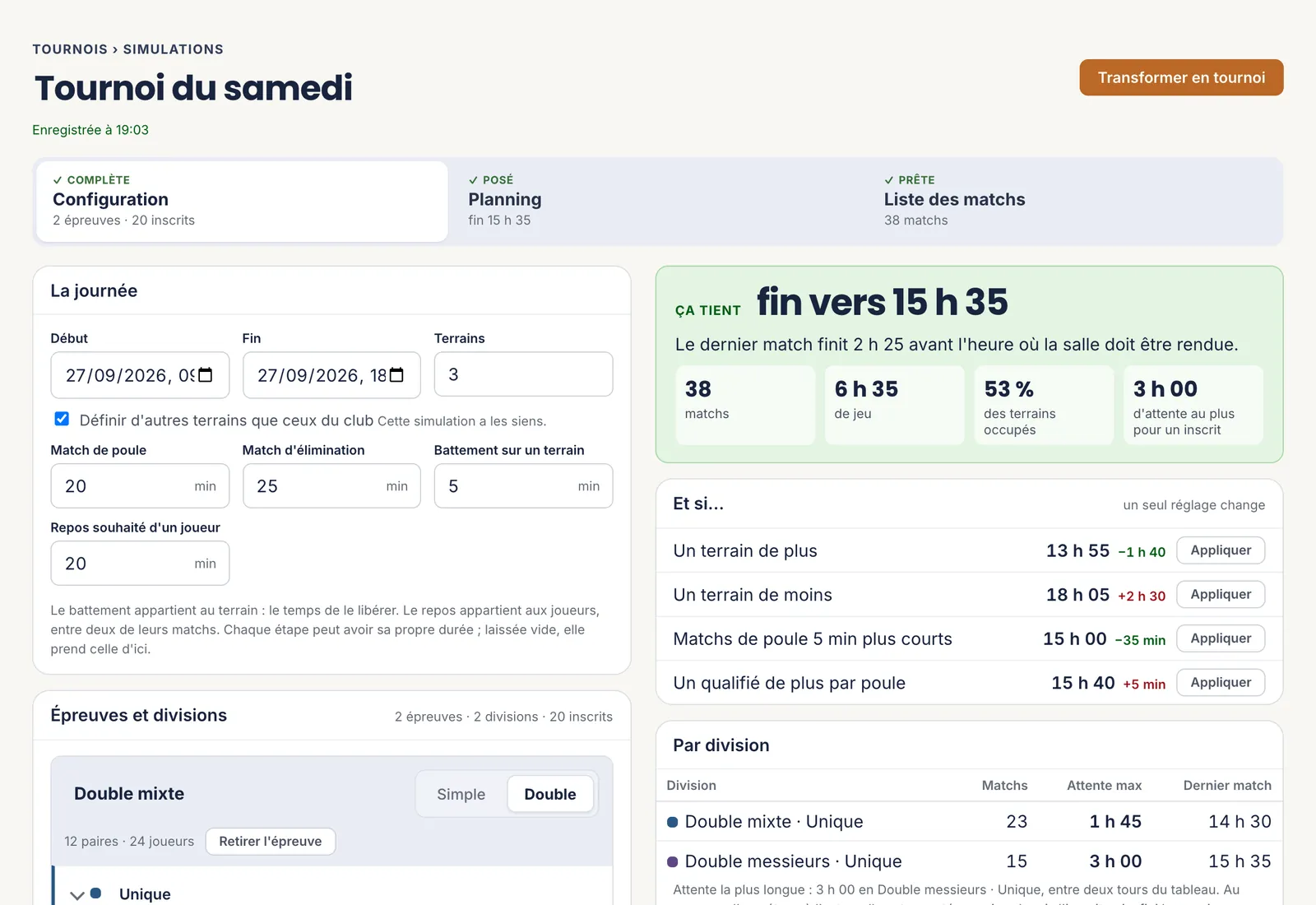
“It fits, finishing around 3:35 pm”

The verdict sits at the top of the screen, against the time the hall has to be handed back: it fits, it is tight, or it runs over. With the number of matches, how busy the courts are, and the longest wait a pair has between two of its matches.

  • “What if…”: one more court, shorter pools, one more qualifier, each with its finishing time
  • Each variant applies in one click
  • A format the draw would refuse is flagged, well before the day
A simulation: the day from 9 am to 6 pm on three courts, the verdict “It fits, finishing around 3:35 pm”, 38 matches, and the “What if…” variants with their finishing times

Over one day or a whole weekend

Each day has its hours, each court its name. You see the grid court by court, and you can place a pool yourself before letting the scheduler do the rest. When the committee agrees, the simulation becomes the tournament in one click.

  • The same engine as the real schedule, not a separate estimate
  • Events, divisions, formats and courts carried over on creation
  • Still to set: the prices, the venue, the opening of entries
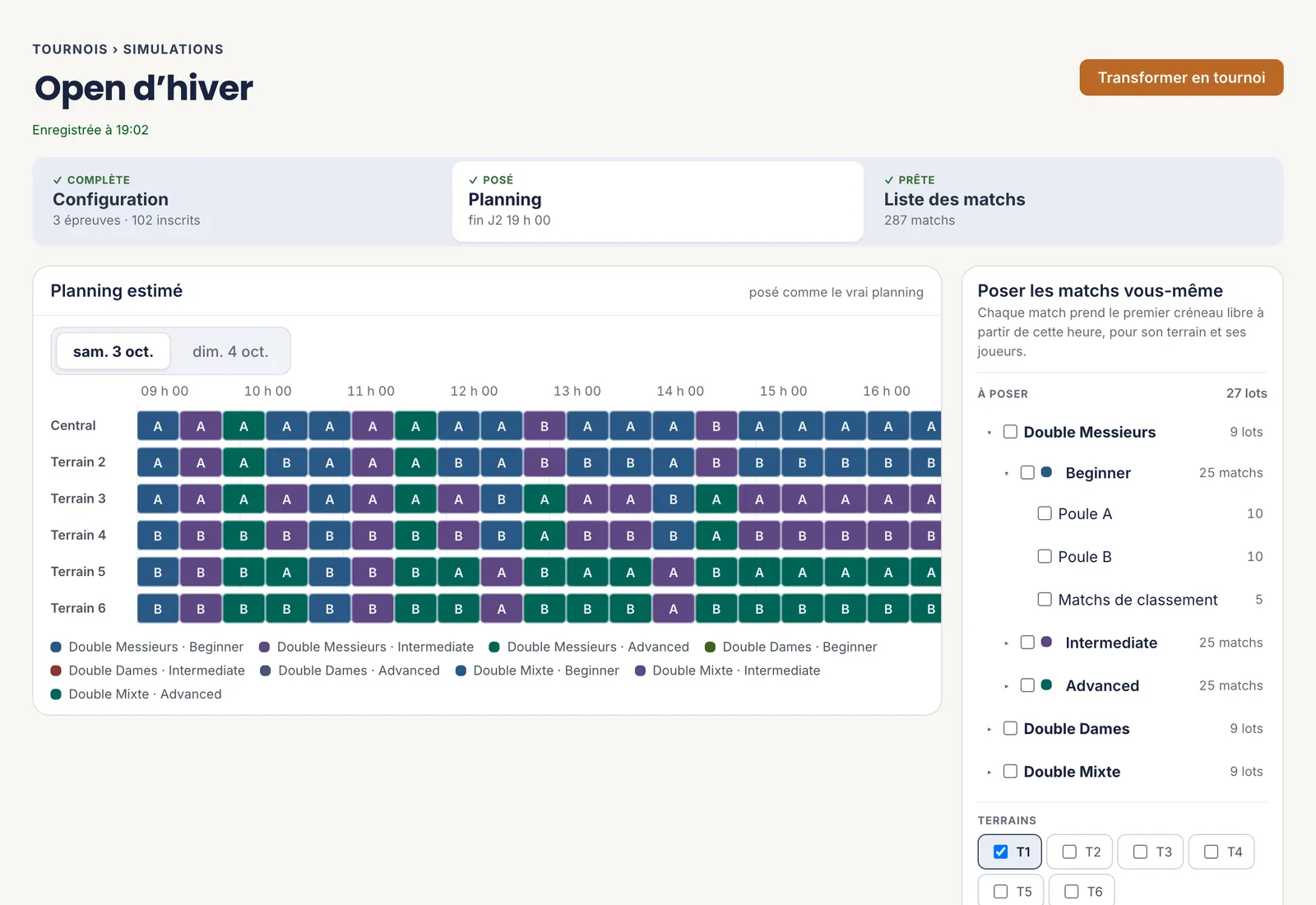
The estimated schedule of a two-day simulation: six courts filled with pool matches, and on the right the panel for placing matches yourself

The five stages of a tournament, and the next action

Prepare, register, compose, play, publish. Each stage opens on what is left to do: a volunteer who takes the tournament over a year later knows where things stand without having to remember anything.

  1. Prepareevents, prices, venue, poster
  2. Entriespairs, payments, waiting list
  3. Composedivisions, format, schedule
  4. Match dayscoring table, check-in
  5. Resultspodiums published
01

Prepare, and know what it brings in

Events, prices, extras (dinner, T-shirt), hall and poster: a list of things to settle, ticked off as you go. The price can go down for further events, and the screen estimates what the club takes in if every place is filled, commission deducted.

  • The club’s courts named once, reused for every tournament
  • Public tournament or by invitation, through a link
  • The next edition takes everything over, except the players
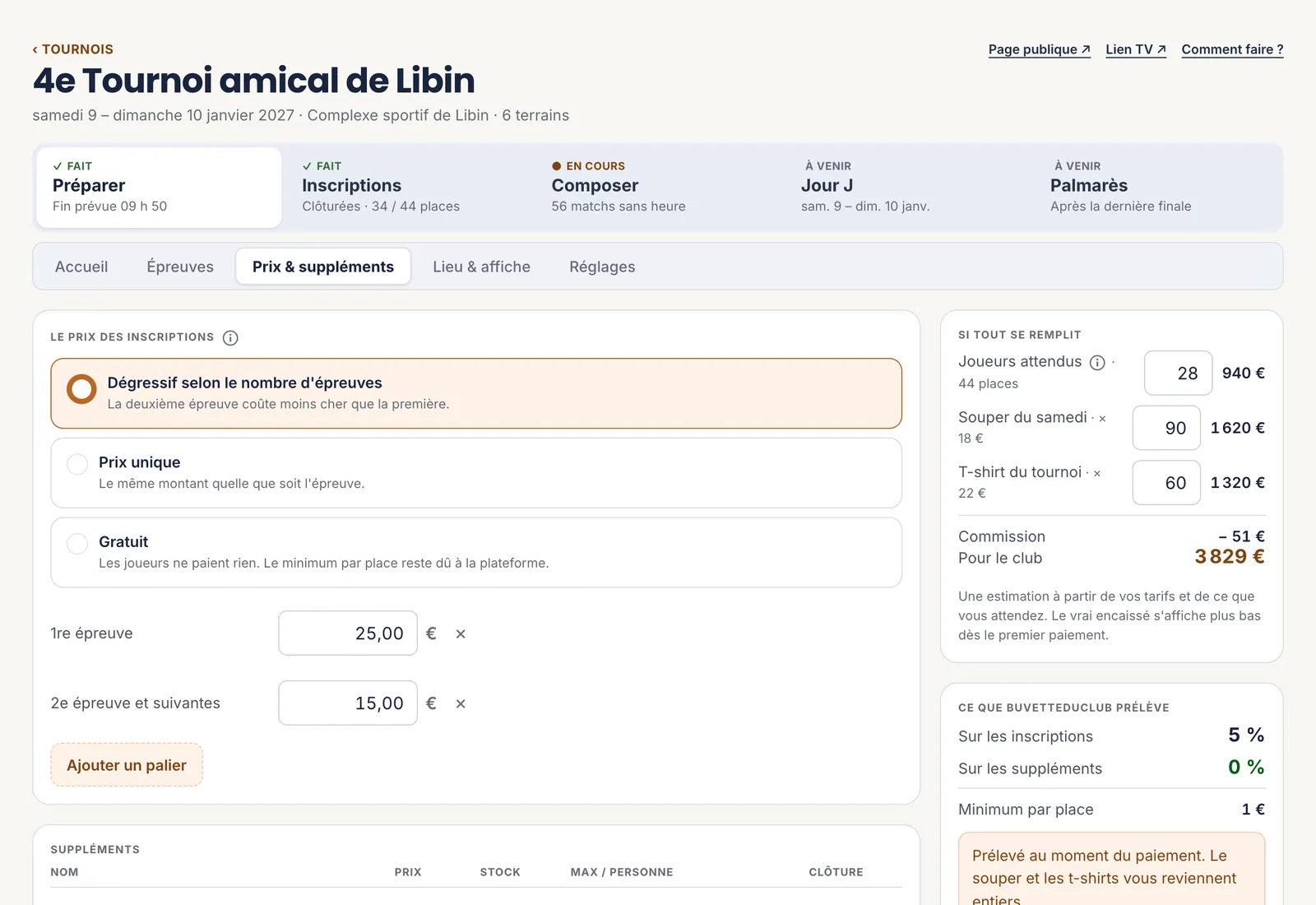
The prices of a tournament: €25 for the first event, €15 for the next ones, and on the right the takings if every place is filled, commission deducted
02

Registrations fill up on their own

Players register as a pair, or alone for a singles or Americano event. Their partner’s place is held while the partner confirms, and it counts as taken. They pay by Bancontact or card, on a page in the club’s name, or confirm and pay at the bar.

  • The partner is named by email address, or by player code (K7M4-2QX9)
  • A waiting list that moves up on its own before the draw
  • The bar and its takings for the day, with no Bancontact or card fees
  • A withdrawal refunded in one click; tournament cancelled, everyone told
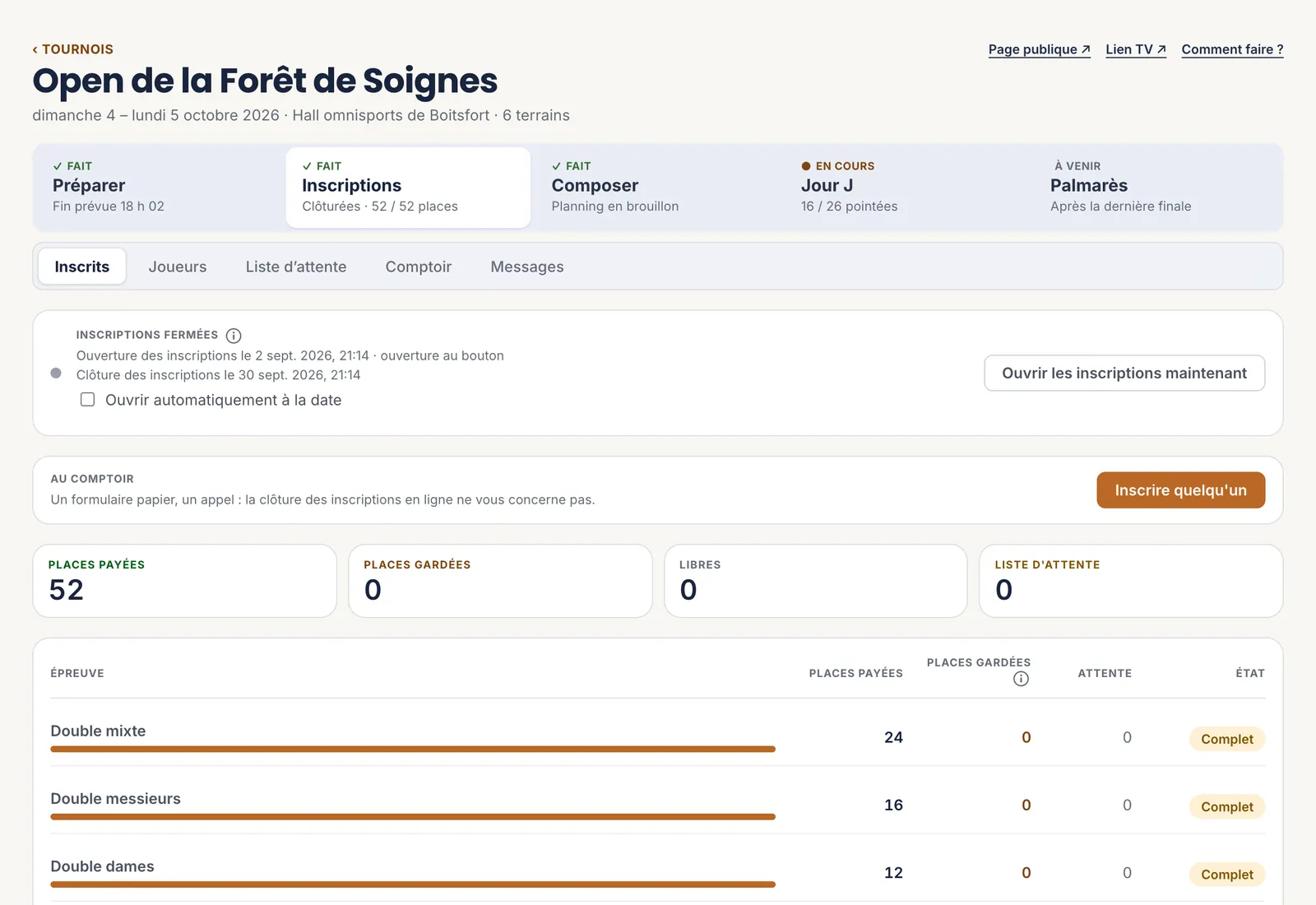
A tournament’s entries: 52 of 52 places paid, three full events, and the button to enter someone at the bar
03

Compose: the format, the draw, the schedule

Pairs are placed by level in your divisions, the format proposed by the simulation is recalculated on the pairs actually registered, and the draw follows. The schedule offers three versions to compare: the one that finishes earliest, the one that leaves time to breathe, the one that groups the events.

  • Pools, best runners-up, knockout, double elimination, placement matches
  • Americano, Mexicano, up and down for players who come alone: every format (page in French)
  • A match moves by dragging it, and stays put afterwards
  • Rest counted per player, across all events
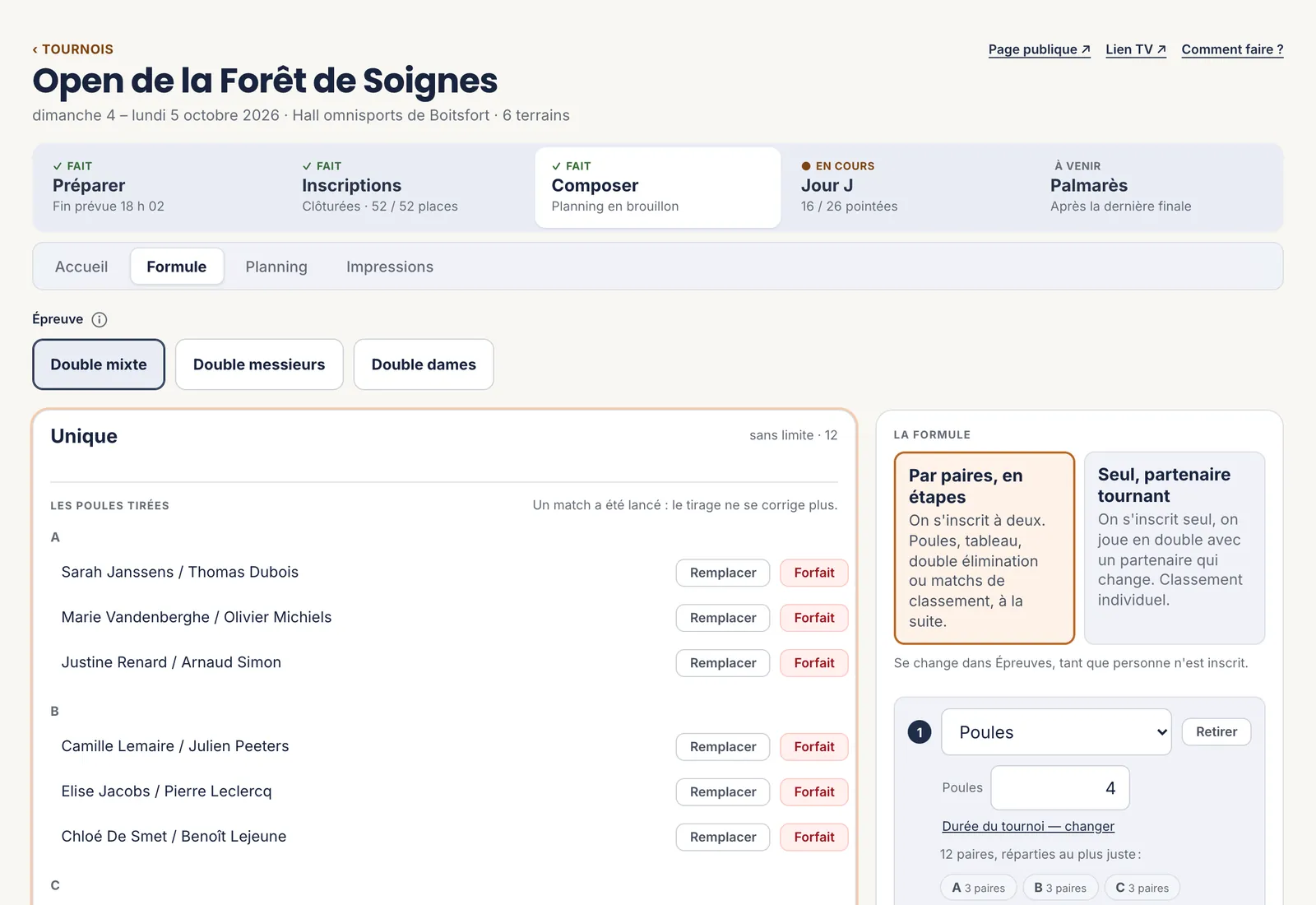
The format and draw of a mixed doubles: the drawn pools, and beside them the format, four pools with the top two going through
04

The day fits on one screen

One court, one card: the planned time, the match (“Pool B · match 7”, “Quarter-final 1”) and a button labelled with the next action: start, finish, correct. The day’s home screen says which court is waiting, and who has not arrived yet, with the time of their first match. Over two days, each day has its own table.

  • Check-in player by player: each arrives on their own
  • Pools and brackets live, event by event
  • Every match of the day, searchable by name, pool or court
  • Match sheets printed, with an example first
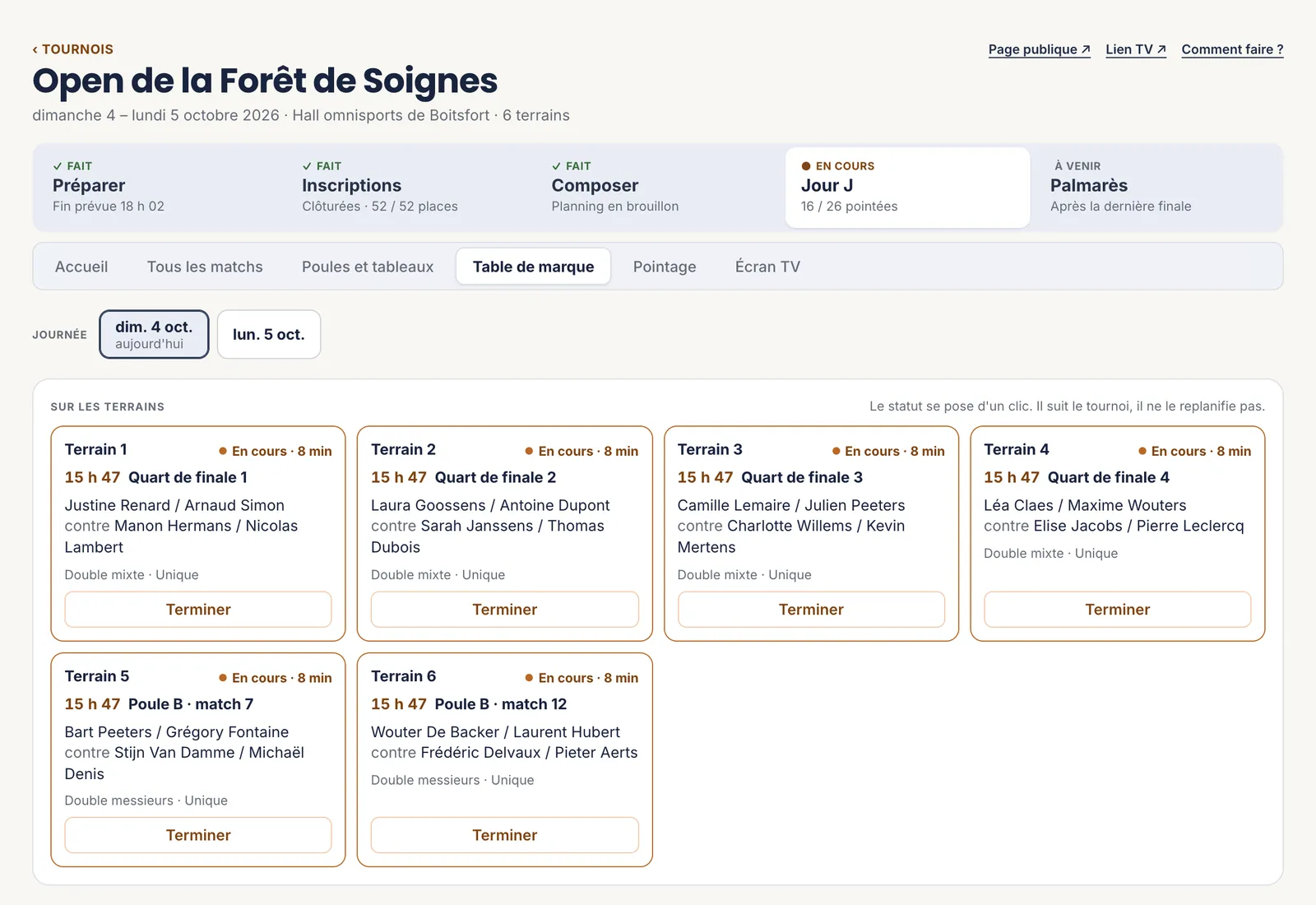
The scoring table: six courts in play, each with the planned time, the name of the match, its two pairs and the button to finish the match
05

Live, then the results

In their space, each player sees their day: their matches of the day across all their events, their pool, their path to the final, and the matches they will play if they win. Pools, brackets and the full schedule can be searched by name. Finished podiums are published in one go, and a score corrected afterwards is flagged. After the last final, the matches played come out as a file ready to upload to DUPR.

  • One player account for every club
  • A message to the players, in their language
  • The DUPR import file, ready to upload
  • How a pool is decided (page in French)
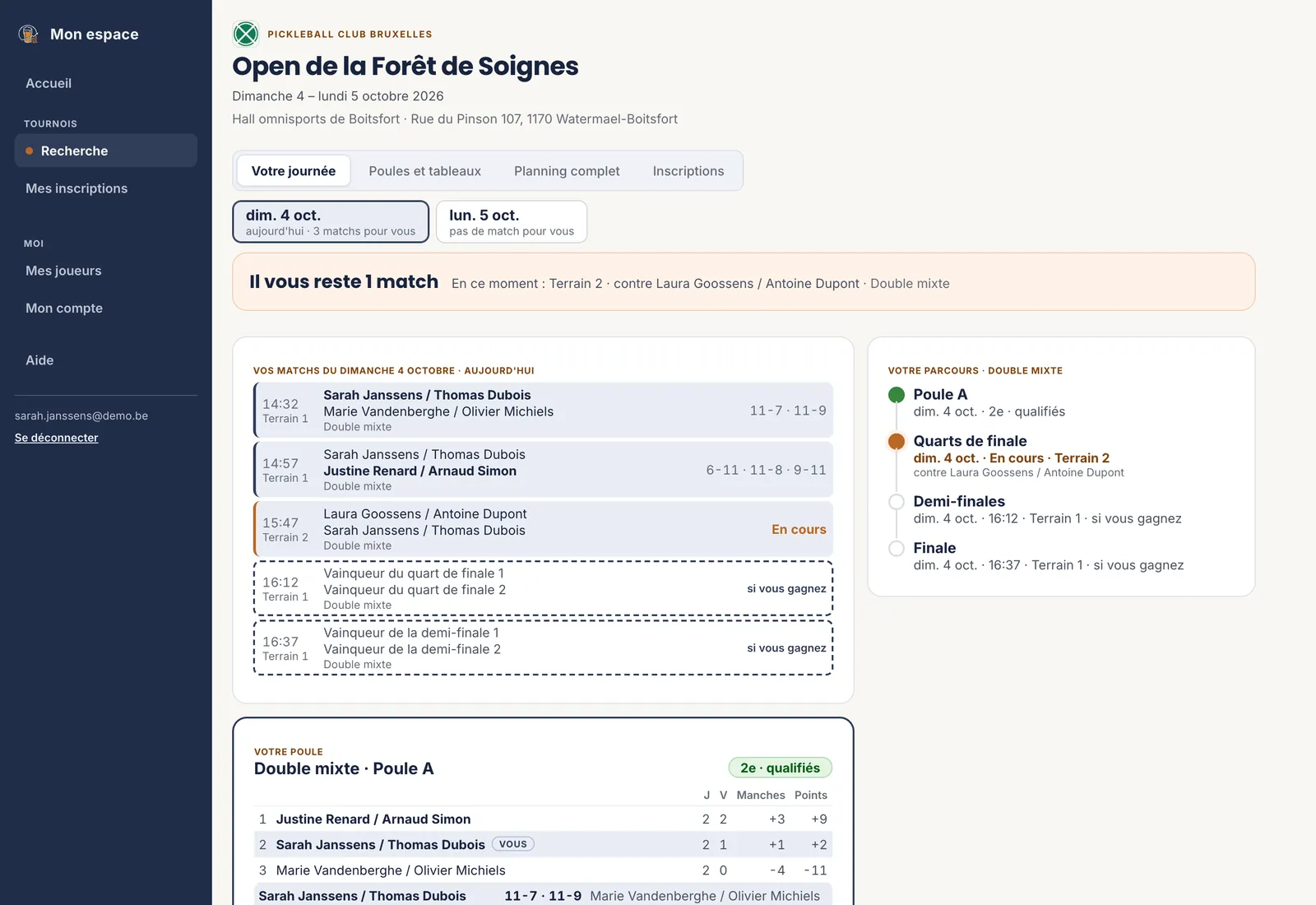
“Your day” in a player’s space: one match left, her matches of the day with the semi-final and final dashed “if you win”, and her path from pool A to the final
On the TV at the bar

Players watch the screen, not the bar

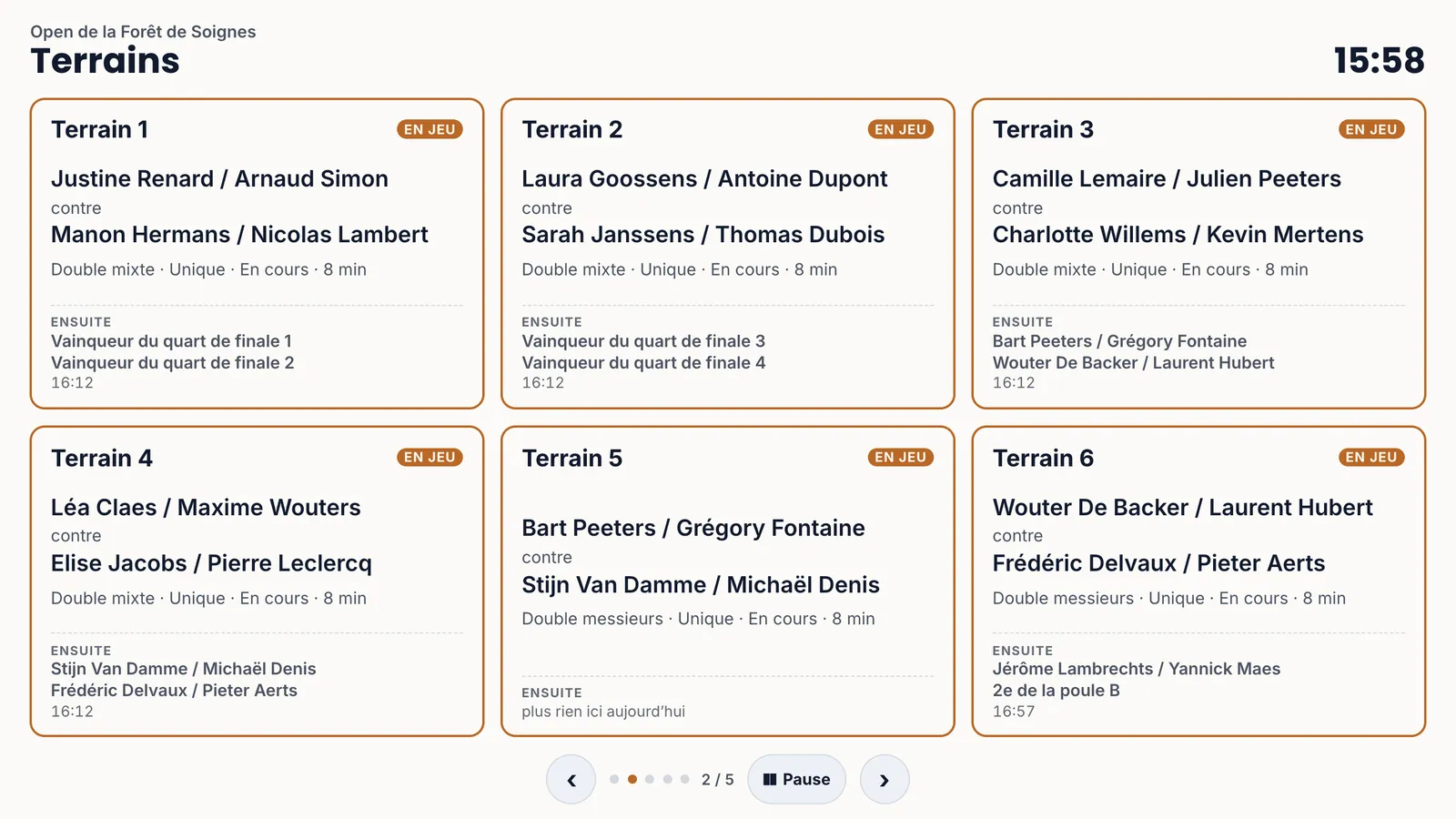
One link, opened once on the TV in the hall, and the screen cycles on its own: courts in play and the next match, the schedule with a line marking the time, ranked pools with their matches, the brackets. It shows only the current day and refreshes itself. Nobody comes to the bar to ask when they play.

  • You choose the views, their order, their length and the events shown
  • Each view in its own language: the schedule in French, then in Dutch
  • Fits any TV, with nothing to install
  • The same link opens on a phone, and flips through with a thumb
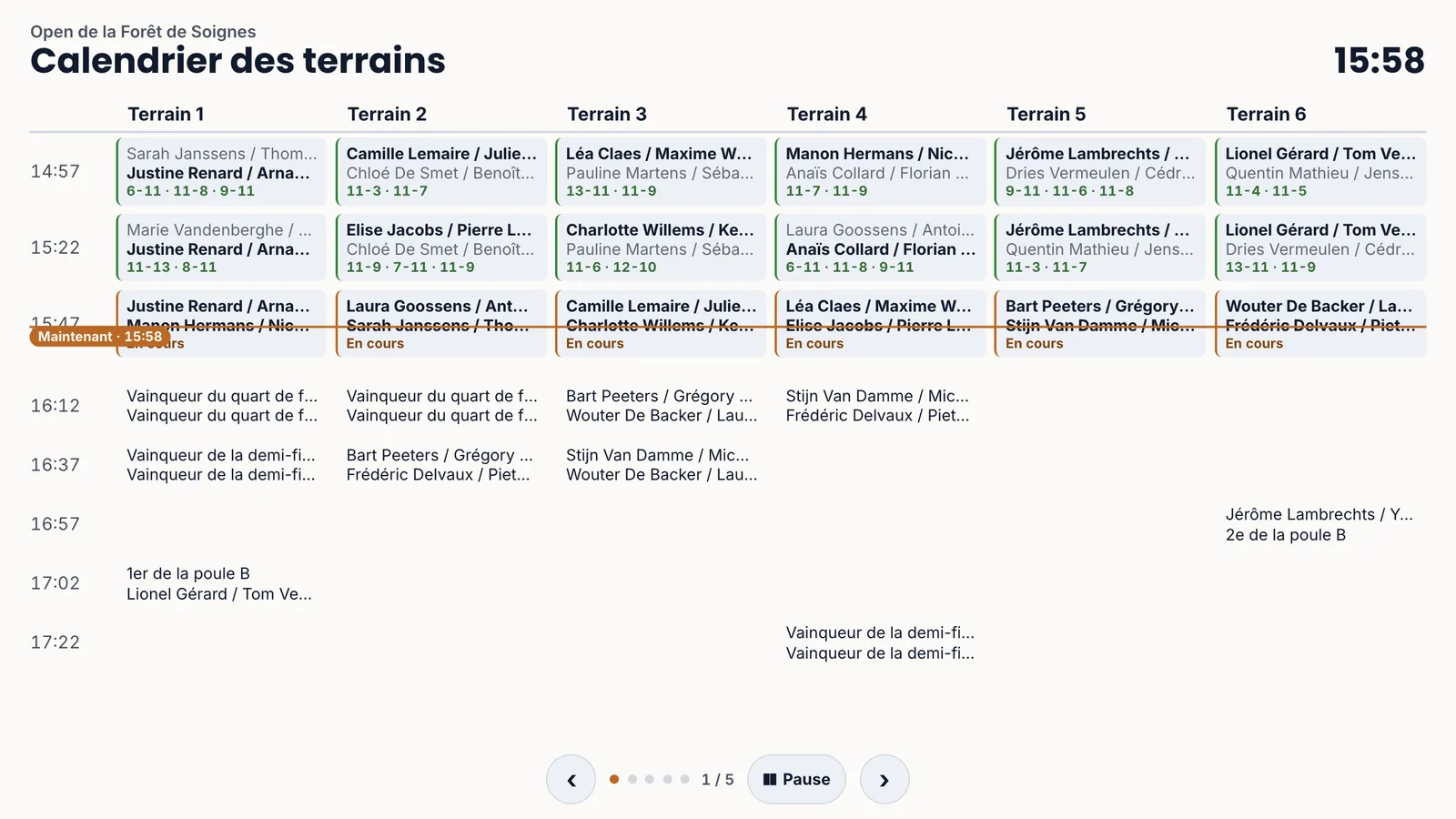
The bar screen on its courts view: six courts in play, each with its two pairs and the next match

What a tournament costs the club

No subscription: 5% of each place’s price, with a €1 minimum per place, online or at the bar. Someone playing two events takes two places.

Your prices, your entries

Entry prices
Players pay

all events together: a player in doubles and mixed takes two

Your tournament
80 players → €140 for us, €2,460 for the club

How the price is worked out

Our share, per place = the larger of the two: 5% of the place’s price, or €1.

  • A place is one player in one event. Someone playing the doubles and the mixed takes two places, and each one counts.
  • With degressive pricing, each player pays their first event at the first tier and the next one at the tier after. 120 places for 80 players means 80 first events and 40 second ones.
  • Online or at the bar, the calculation is the same. Online, an advance is taken at payment. The rest, including places paid at the bar and free places, is invoiced to the club after the tournament.
  • Not included: Stripe’s Bancontact and card fees, paid by the club. Extras (dinner, T-shirt) carry no commission.

The club’s subscription, if it has one, does not cover its tournaments. Full pricing.

What it does not do
  • No court booking, neither on tournament day nor for the rest of the year.
  • No federation licences or national ranking; no referee call-ups by email.
  • Double elimination needs 2, 4, 8 or 16 pairs, up and down a multiple of four players.
  • Results go to DUPR as a file you upload yourself, not yet directly; no text messages.
The right size
A club tournament, not a national championship.

If your club runs an open for three hundred players with official referees and licences to check, other tools do that better. This is Saturday’s tournament: a hundred and twenty players, six courts, three events, and a committee that would like to have dinner in the evening.

Frequently asked questions

Can you know whether the tournament fits before you open it?
Yes, that is what the simulation is for. You give the events, the number of pairs you expect, the format, the courts and the hours; it places every match the way the real schedule will and gives the finishing time, day by day. When you are happy with it, it becomes the tournament in one click.
Do you need a payment account to open a tournament?
No. A free tournament opens without a payment account, and so does a club that prefers to collect at the bar: players then confirm their registration online and pay on site. For online payment, the club connects its own Stripe account: the money goes to the club, not to us, and the club’s name appears on the player’s bank statement.
How does registering as a pair work?
The person registering names their partner by email address, or by the player code the partner gave them. The partner’s place is held while they confirm, within a time limit the club sets, and it counts as taken during that time. Anyone who prefers to pay for both does so in one go, and there is nothing left to wait for.
What happens when a player withdraws?
Their place goes back to registrations and their entry is refunded, commission included if the club wishes. Before the draw, the first on the waiting list takes the place automatically. After the draw, nothing enters automatically: a bracket already drawn is not completed without someone deciding.
Does the schedule respect players’ rest?
It counts rest per player, across all events: someone playing the mixed and the doubles does not play their two matches back to back. When six courts leave no choice, the schedule names the players concerned, with the time and the event, before the tournament rather than at the bar.
Can the bar screen speak two languages?
Yes. The screen has a language, and each view can have its own: the same view comes round several times, in different languages — the schedule in French, then in Dutch, for a hall where both are spoken. Nothing changes on the players’ phones: each reads in their own.
Does it handle DUPR?
Partly. Each player can add their DUPR ID to their profile, and a tournament that counts for DUPR requires it: nobody registers without one, not even at the bar. After the tournament, the matches played come out as a file in DUPR's import format, with each player's ID. You then upload it in the DUPR club space. Ratings are not yet read from DUPR: the organiser places the pairs once entries have closed.
Can you run an Americano or a Mexicano?
Yes. An event is set up as “Alone, rotating partner”: everyone registers alone, the partner changes every round, and the ranking is individual, by points scored. Americano, mixed Americano, Popcorn, Mexicano, up and down and Gauntlet: what each format does (page in French).